

Spring Forward
Wildflower season in the Santa Monica Mountains.

I’ve been coming to Los Angeles my whole life, but it wasn’t until I moved to Topanga Canyon a decade ago that I grasped the scale of the Santa Monica Mountains.
By this I mean the vast open spaces in the Santa Monica Mountains National Recreation Area. That’s the name of the sprawling network of parklands on L.A.’s Westside. Said to be the largest urban park in the country, the SMMNRA spans more than 150,000 acres. Its boundaries extend north to the Simi Hills, west to Point Mugu, south to Point Dume and east to Franklin Canyon. Chances are you’ve been to a few of the parks without knowing it. Zuma, Leo Carrillo, Malibu Lagoon, Will Rogers—all part of the preserve.
It’s incredible that this much coastal land is protected in Southern California. I’d say it’s a miracle, but it is actually the result of a years-long campaign by three women—Jill Swift, Sue Nelson and Margot Feuer—who fended off developers long enough to get the preserve established as part of the National Parks and Recreation Act of 1978. If not for their vision, several canyons could have been turned into landfills, Malibu Canyon may have become a freeway, and we might never have known that the Santa Monicas have a spectacular wildflower season.
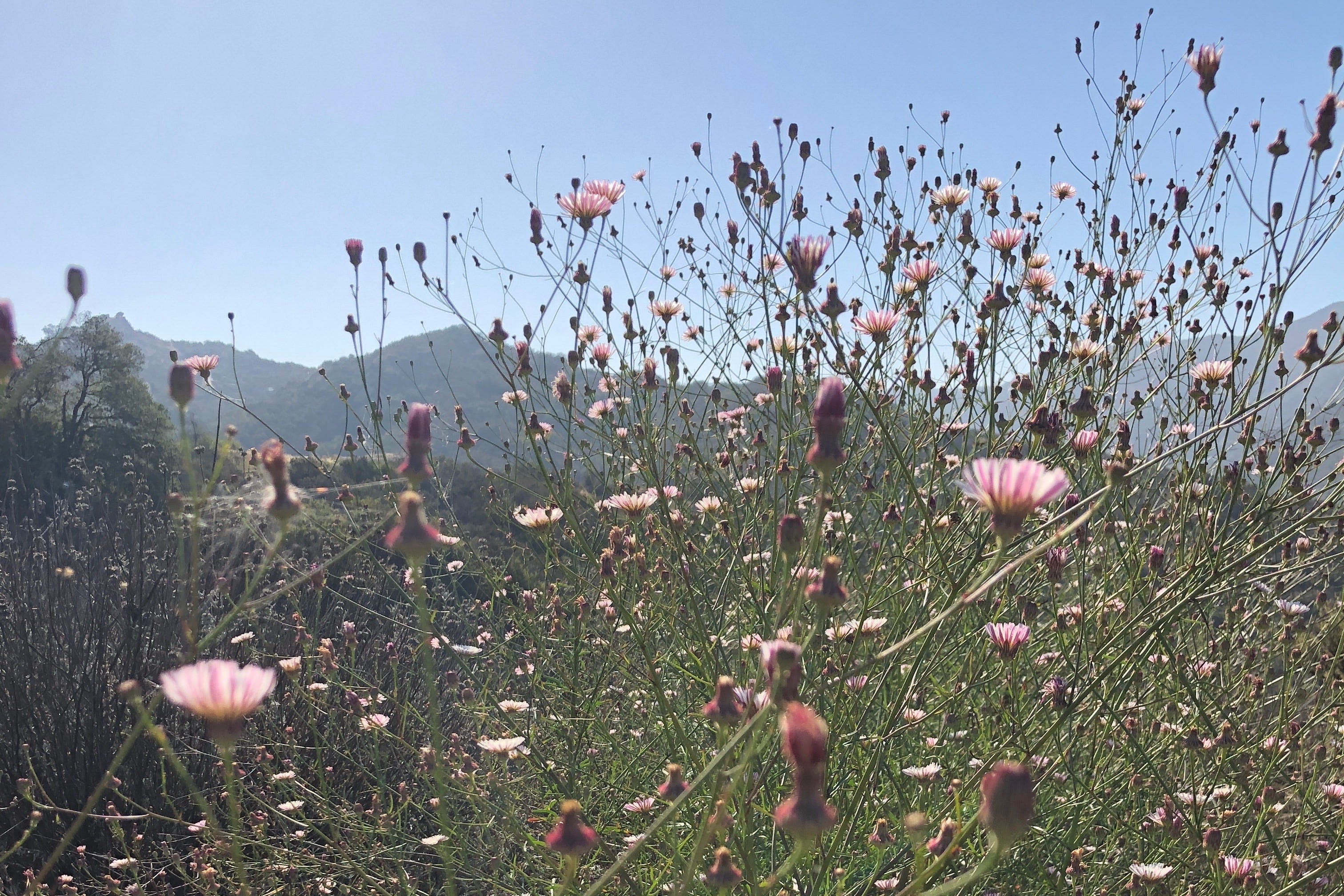
The season usually begins in March and lasts through May, with the peak arriving sometime in April. But it appears to have gotten an early start this year, I noticed on a recent walk in Topanga State Park.
It was the middle of February and the fire road to Eagle Rock was already lined with wildflowers. Arroyo lupine, hummingbird sage, morning glory, rabbit tobacco, canyon sunflower, Indian paintbrush, wild cucumber, sticky monkey and at least one cobweb thistle were in bloom, streaking the hills with yellow, purple, fuchsia, red, creamy white and dusty orange. Scattered along lower sections of the trail were golden yarrow and pale pink California buckwheat.
This week’s rain brought more purple lupine, along with its pinkish cousin, the stinging lupine, one of many “fire followers” that grow in these parts—native flowers that turn up after wildfire clears away the chaparral.
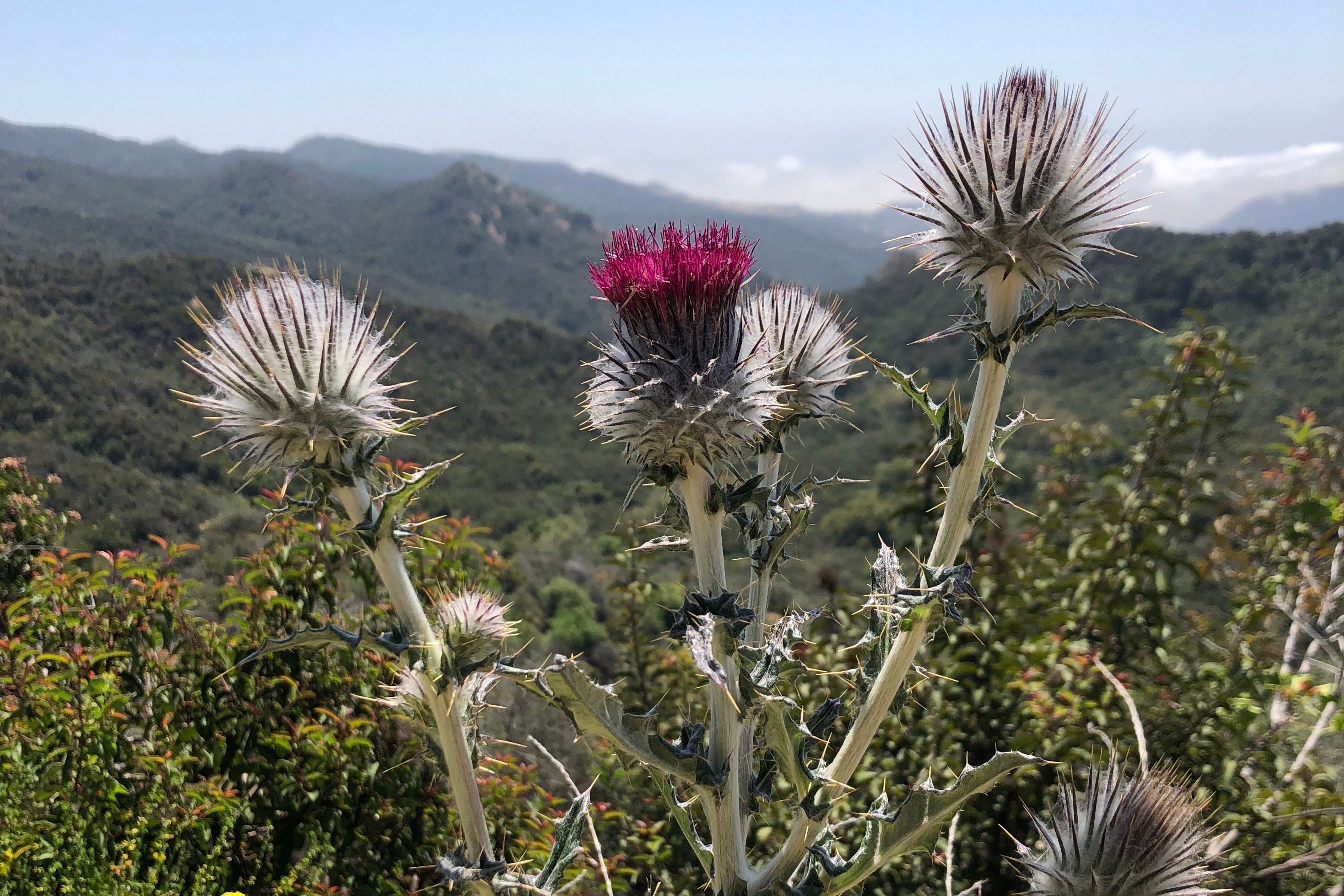
If this keeps up, March is going to be lousy with wildflowers. California poppies, goldfields, wild hyacinth and other spring blooms will pop up at lower elevations first, some in shady canyons and others on sunny, south-facing slopes.
To see dense patches of color ahead of schedule, Musch Trail is a good bet. So are the meadows at Malibu Creek State Park. The bluffs above Point Dume and Point Mugu also tend to bloom on the early side.
By late March there could be blankets of flowers. More lupine, poppies, goldfields and hyacinth, probably with bush sunflowers, coreopsis, baby blue eyes, padre’s shooting stars, tidy tips and phacelia. This will be a great time to go to Parker Mesa Overlook. The route from Trippet Ranch follows a dramatic ridge line with blooming slopes on either side and stunning views of the Pacific.

Hundreds of wildflower species grow in the Santa Monicas, and you never know which will show up en masse when the season peaks. In coastal sage scrub, a.k.a. soft chaparral, you’re likely to see wild sweet pea, golden star, pin cushion, cream cups, owl’s clover, evening primrose, sand verbena and purple sage.
Higher up in the chaparral, you may come across black sage, globe gilia, wild roses, wild lilacs, blue larkspur, penstemon and Catalina mariposa lilies. Keep an eye out for Chinese houses, named for their tiers of purple and white flowers that resemble pagodas. They like to grow under oak canopies and along shaded trails. The elusive chocolate lily can also be found in shady spots, along with bell-shaped globe lilies, sometimes called fairy lanterns.
This is a good year to look for fire followers. Fire poppies, redder than their orange cousins, bloom only after wildfire smoke triggers their seeds to germinate. Purple phacelia can bloom any spring but becomes much more abundant after a fire. Same goes for whispering bells, woolly blue curls, fiesta flowers and violet snapdragons.
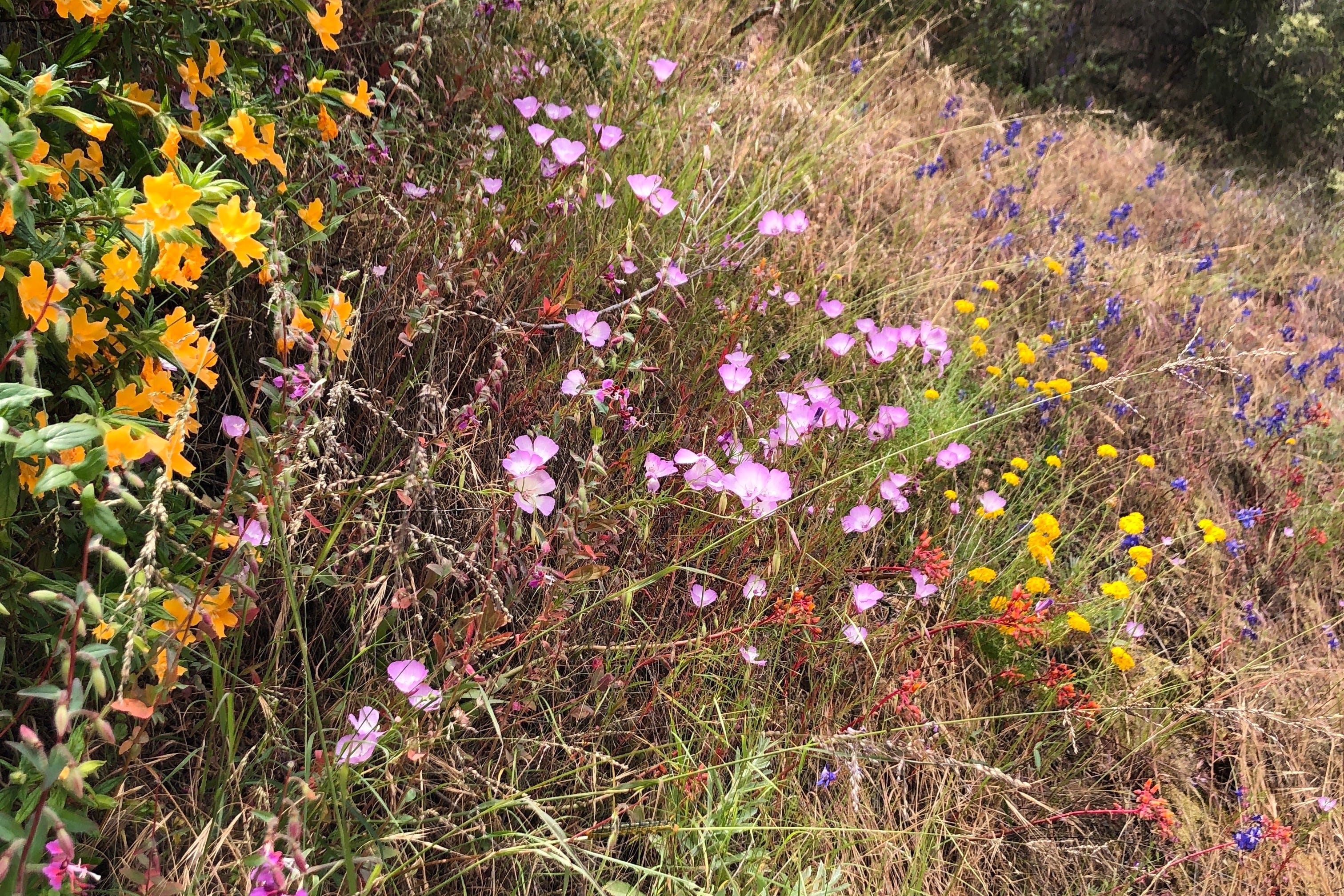
April brings an explosion of color to most areas. It’s hard to go wrong in Topanga State Park, which has thirty-six miles of trails, many with ocean views. Parts of the park burned in the Palisades fire, so fire followers might run riot there.
I always see spring flowers in Red Rock Canyon Park, which is less busy and gorgeous in a way that resembles slickrock country. From the trailhead it’s about two miles to Calabasas Peak. Tuna Canyon Park is also out of the way and crazy beautiful—1,200 acres facing the ocean, never crowded, and dogs are allowed.
The meadows at Charmlee Wilderness Park, a former ranch with stately old oaks and commanding views of the coast, produce lovely blooms. I’ve never been but some people swear that Triunfo Creek Park, near Agoura, has the most varied and striking wildflower display around.


By mid-May, lower elevations will be drying out, and the lupine and poppies will be fading. One bloom that won’t be waning is black mustard, which has taken over the foothills here in recent years.
This invasive weed—“mustard of unusual size,” as an assistant fire chief once described it to me—can grow to be ten feet tall. It’s bad for native wildflowers and extremely combustible but fun to walk through. Honey bees swarm the plant, and in giant patches like the ones in Cheeseboro Canyon, their collective buzz creates a constant low-frequency hum.
Some native late bloomers will be going strong through May and into June, especially at higher elevations and on north-facing slopes. The tall, hardy chaparral yucca lights up hillsides with pearlescent blossoms. The exquisite Plummer’s mariposa lily also favors dry, rocky terrain. It’s usually scarce but can flourish in burn scars.
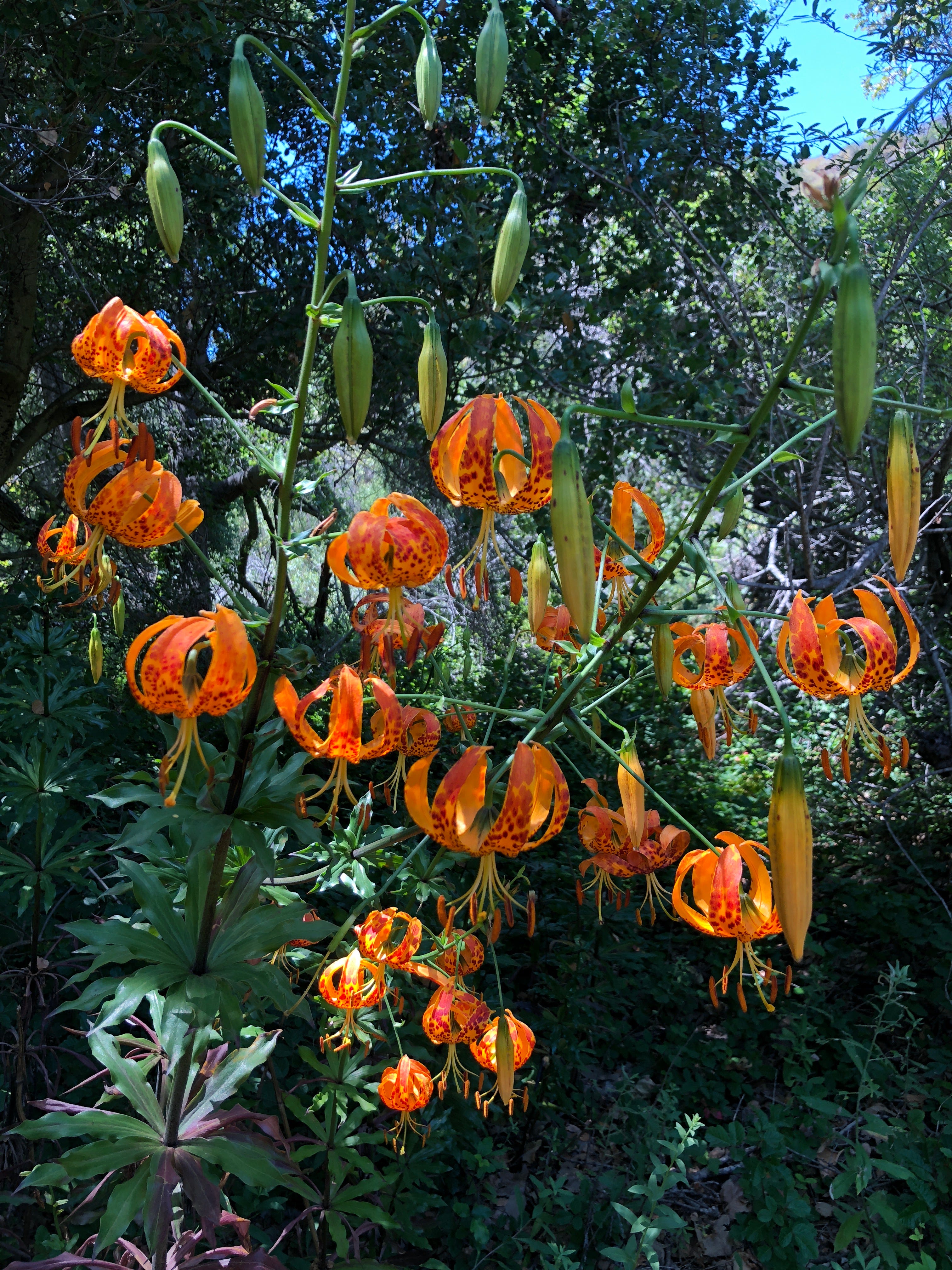
One of my favorite summer flowers is the Humboldt lily. These California natives bloom every year from May to July along the Santa Ynez Canyon Trail in Topanga State Park. Bright orange with maroon spots, they hang from tall stalks in dense clusters, sometimes with dozens of flowers on a single plant. Seeing them in the canyon is like coming across a Chinese New Year scene in the wild. Up close they give off a sweet, faintly spicy scent.
For weekly reports on what’s blooming around Southern California, you can call the Theodore Payne Foundation’s wildflower hotline starting on March 6. California State Parks also has a bloom tracker, and you can keep tabs on the Antelope Valley California Poppy Reserve via its poppy cam. For help identifying flowers in the Santa Monicas, try the recreation area’s flower finder. The California Native Plant Society maintains a more comprehensive database and recently published an excellent field guide.
Can't wait to check out the poppy cam!
Thanks for this beautiful piece.
Wow! Just beautiful! Wish I lived closer to take a walk through those glorious wildflower meadows.
And thanks for sharing the story about Jill Swift, Sue Nelson and Margot Feuer. It's a good reminder that in the world we live in, places like this need to be proactively protected. Grateful for the vision and actions of these three women decades ago.